From Popbitch:
Bafta balls-up: Nightmares for the BBC
The Power of Nightmares, the programme about how news media distorted coverage of the war on terror which Popbitch promoted last Autum, won a Bafta last week. When its helmer Adam Curtis made his acceptance speech about the ludicrous coverage of the recent Ricin trial and, with fabulous irony given the subject matter of the show, the speech was cut out completely from the TV coverage.
Newspaper coverage of the Ricin trial alleged that it meant "consequences beyond 9/11." The reality? Eight men acquitted and no evidence of ricin found. Just one man, Kamal Bourgass was found to have been trying to make nicotine poison. But at Porton Down, the Government’s biological experimentation centre, when they tried to use this poison on mice, they couldn't even kill them with it. The mice just got a bit queasy and had to be put down.
Still, the programme’s plaudits continue. This week it's being feted at the Tribeca Film Festival, and next week it's the only British film to be shown at Cannes.
A speech about media distortion is distorted... No wonder the BBC has a reputation be being the Ministry of Truth. Guess they've learned to stay on Bliar's side since the Hutton Report.
20 November, 2005


Ricin Ring
From Chicken Yoghurt:
A couple of weeks ago, I wrote a piece about the Ricin terrorist plot in Britain that turned out to be cobblers. In the piece I linked to an article in the Guardian by Duncan Campbell that took the case to pieces and showed it for the horseshit it was. That piece has now been pulled from the Guardian website for "legal reasons".
"Legal reasons" as in a D-Notice (or an equivalent) has been served.
More from The Register:
A Guardian story on "The ricin ring that never was" has been pulled from the newspaper's website, for what are said to be 'legal reasons'. The story, by Duncan Campbell (the investigative writer, not the Guardian journalist of the same name), analysed the collapse of the UK's 'ricin conspiracy' trial, and reported Porton Down evidence that had made it clear that claims of mass poisoning attacks had no basis.
Campbell's piece had named a Porton scientist who had given evidence, but the names of Porton Down scientists are not a state secret. Or they weren't, anyway. A Public Interest Immunity Certificate is a relatively seldom-used legal mechanism for placing restrictions on evidence. According to the Crown Prosecution Service "the government now considers that where government documents or information are material to legal proceedings, PII will only arise if disclosure could cause real damage to a genuine public interest.
If a PII did constitute the "legal reasons" it's difficult to see where the public interest in the action lies. The removal of the article does however mean that one of the very few correctives to widespread 'UK 911 poison terror scare' hysteria no longer exists in the mainstream press. Au contraire; the weekend after the end of the trial and the publication of the evidence, the Sunday Telegraph reported that we were/are faced with "chaos and panic in London's public transport system", and our security forces narrowly averted "our September 11, our Madrid. There is no doubt about it, if this had come off this would have been one of al-Qa'eda's biggest strikes", a "senior officer at Scotland Yard" told the paper.
A copy of the original article can be found here or here (for how long before it goes down the memory hole who knows?). Anyway, it's another reason in favour of a US-style 1st Amendment.
In case it dissappears, here's the article in full:
Fake Terror - Ricin Ring That Never Was Yesterday's trial collapse has exposed the deception behind attempts to link al-Qaida to a 'poison attack' on London By Duncan Campbell The Guardian - UK 4-15-5
Colin Powell does not need more humiliation over the manifold errors in his February 2003 presentation to the UN. But yesterday a London jury brought down another section of the case he made for war - that Iraq and Osama bin Laden were supporting and directing terrorist poison cells throughout Europe, including a London ricin ring.
Yesterday's verdicts on five defendants and the dropping of charges against four others make clear there was no ricin ring. Nor did the "ricin ring" make or have ricin. Not that the government shared that news with us. Until today, the public record for the past three fear-inducing years has been that ricin was found in the Wood Green flat occupied by some of yesterday's acquitted defendants. It wasn't.
The third plank of the al-Qaida-Iraq poison theory was the link between what Powell labelled the "UK poison cell" and training camps in Afghanistan. The evidence the government wanted to use to connect the defendants to Afghanistan and al-Qaida was never put to the jury. That was because last autumn a trial within a trial was secretly taking place. This was a private contest between a group of scientists from the Porton Down military research centre and myself. The issue was: where had the information on poisons and chemicals come from?
The information - five pages in Arabic, containing amateur instructions for making ricin, cyanide and botulinum, and a list of chemicals used in explosives - was at the heart of the case. The notes had been made by Kamel Bourgass, the sole convicted defendant. His co-defendants believed that he had copied the information from the internet. The prosecution claimed it had come from Afghanistan.
I was asked to look for the original source on the internet. This meant exploring Islamist websites that publish Bin Laden and his sympathisers, and plumbing the most prolific source of information on how to do harm: the writings of the American survivalist right and the gun lobby.
The experience of being an expert witness on these issues has made me feel a great deal safer on the streets of London. These were the internal documents of the supposed al-Qaida cell planning the "big one" in Britain. But the recipes were untested and unoriginal, borrowed from US sources. Moreover, ricin is not a weapon of mass destruction. It is a poison which has only ever been used for one-on-one killings and attempted killings.
If this was the measure of the destructive wrath that Bin Laden's followers were about to wreak on London, it was impotent. Yet it was the discovery of a copy of Bourgass's notes in Thetford in 2002 that inspired the wave of horror stories and government announcements and preparations for poison gas attacks.
It is true that when the team from Porton Down entered the Wood Green flat in January 2003, their field equipment registered the presence of ricin. But these were high sensitivity field detectors, for use where a false negative result could be fatal. A few days later in the lab, Dr Martin Pearce, head of the Biological Weapons Identification Group, found that there was no ricin. But when this result was passed to London, the message reportedly said the opposite.
The planned government case on links to Afghanistan was based only on papers that a freelance journalist working for the Times had scooped up after the US invasion of Kabul. Some were in Arabic, some in Russian. They were far more detailed than Bourgass's notes. Nevertheless, claimed Porton Down chemistry chief Dr Chris Timperley, they showed a "common origin and progression" in the methods, thus linking the London group of north Africans to Afghanistan and Bin Laden.
The weakness of Timperley's case was that neither he nor the intelligence services had examined any other documents that could have been the source. We were told Porton Down and its intelligence advisers had never previously heard of the "Mujahideen Poisons Handbook, containing recipes for ricin and much more". The document, written by veterans of the 1980s Afghan war, has been on the net since 1998.
All the information roads led west, not to Kabul but to California and the US midwest. The recipes for ricin now seen on the internet were invented 20 years ago by survivalist Kurt Saxon. He advertises videos and books on the internet. Before the ricin ring trial started, I phoned him in Arizona. For $110, he sent me a fistful of CDs and videos on how to make bombs, missiles, booby traps - and ricin. We handed a copy of the ricin video to the police.
When, in October, I showed that the chemical lists found in London were an exact copy of pages on an internet site in Palo Alto, California, the prosecution gave up on the Kabul and al-Qaida link claims. But it seems this information was not shared with the then home secretary, David Blunkett, who was still whipping up fear two weeks later. "Al-Qaida and the international network is seen to be, and will be demonstrated through the courts over months to come, actually on our doorstep and threatening our lives," he said on November 14.
The most ironic twist was an attempt to introduce an "al-Qaida manual" into the case. The manual - called the Manual of the Afghan Jihad - had been found on a raid in Manchester in 2000. It was given to the FBI to produce in the 2001 New York trial for the first attack on the World Trade Centre. But it wasn't an al-Qaida manual. The name was invented by the US department of justice in 2001, and the contents were rushed on to the net to aid a presentation to the Senate by the then attorney general, John Ashcroft, supporting the US Patriot Act.
To show that the Jihad manual was written in the 1980s and the period of the US-supported war against the Soviet occupation was easy. The ricin recipe it contained was a direct translation from a 1988 US book called the Poisoner's Handbook, by Maxwell Hutchkinson.
We have all been victims of this mass deception. I do not doubt that Bourgass would have contemplated causing harm if he was competent to do so. But he was an Islamist yobbo on his own, not an Al Qaida-trained superterrorist. An Asbo might be appropriate.
Duncan Campbell is an investigative writer and a scientific expert witness on computers and telecommunications. He is author of War Plan UK and is not the Guardian journalist of the same name.
Statistics
From Private Eye (via Distillated):
Number Crunching:
Number Crunching:
- 24 hours: period terrorism suspects in Australia (al-Qaeda death toll: 88) can be detained before criminal charges must be levelled;
- 5 days: period terrorism suspects in can be detained before criminal charges must be levelled Spain (death toll: 191);
- 7 days: period terrorism suspects in can be detained before criminal charges must be levelled USA (death toll: 3,000);
- 90 days: period government proposes terrorist suspects in UK (Al-Qaeda death toll: 52) should be allowed to be detained before criminal charges must be levelled
TWAT fails - Official!
From the Sunday Times:
THE government’s counter-terrorism strategy is failing, according to a leaked paper by the prime minister’s delivery unit, which was set up to ensure policies work effectively.
In an indictment of Labour’s war on terror, the confidential document says that key policies designed to prevent Al-Qaeda attacks and stop terrorism taking root in Britain are “immature” and “disjointed”.
Not that this’ll stop ‘em trying to pass more pointless, ineffective, abusive “anti-terror” laws…
Others, it adds, are unrelated to the “real world” and show no sign of making progress. … other than clamping down on our freedom…
War on Drugs fails - Official!
Following on from Sunday's post, today the Guardian reported the parts of the report that were originally suppressed by the govt under the FoIA 2000, the actual report is here (PDF).
It says that the traffickers enjoy such high profits that seizure rates of 60-80% are needed to have any serious impact on the flow of drugs into Britain but nothing greater than 20% has been achieved.
The study concludes that the estimated UK annual supply of heroin and cocaine could be transported into the country in five standard-sized shipping containers but has a value which at a conservative estimate tops £4bn.
Among the data suppressed... is a table... showing average street prices for various drugs. It estimates the average cost for a heavy user at £89 a week for cannabis and £525 for crack cocaine - information that is presumably at the fingertips of every hardcore drug abuser and dealer in the country.
Emphasising the inadequacy of seizure rates, the study says the result over the past 10 to 15 years has been that, "despite interventions at every point in the supply chain, cocaine and heroin consumption has been rising, prices falling and drugs have continued to reach users". [i.e. we have an admission that prohibition doesn't work]
It concludes that even if the government succeeded in reducing the availability of drugs, that could backfire because the most addicted, "high harm" users might commit more crimes to fund the purchase of ever more expensive drugs.
Here's my favourite part:
An economic model made for Downing Street shows that the profits per kilo for a major Afghan trafficker into Britain carry a profit margin as high as 58% - higher than Louis Vuitton's margin of 48% or Gucci's 30%.The actual report gives a list of how damaging to society & health various drugs are (p. 19):
Price of coke (£/g) (taking into account increases in purity):
Overall this report is saying that the current prohibition-based drug laws are a complete failure. Hopefully, this will lead to a change in policy; however, the fact that this report was suppressed for 2 yrs (it was originally published in 2003) & the fact that only half of it was originally released via a Freedom of Information Act 2000 release (the rest being held back for reasons of "national security", & was only made available to the public via a leak to the Guardian) would suggest otherwise. This is also suggested by the passing of the Drugs Act 2005, which outlaws the sale of magic mushrooms (which are available in Manchester - I might go & buy some when I go there tomorrow; are they worth £15/30g bag? I dunno...) as of Monday 18th July 2005.
The report also says that there's too big a marketplace & too much of a supply for the drug laws to ever be effective. It's time for legalisation of all narcotics to happen, whether for sale in a specially-licenced shop (equivalent to an off-licence), a chemist, or for prescription from a doctor or heroin-clinic.
See also Transform for their comments.
It says that the traffickers enjoy such high profits that seizure rates of 60-80% are needed to have any serious impact on the flow of drugs into Britain but nothing greater than 20% has been achieved.
The study concludes that the estimated UK annual supply of heroin and cocaine could be transported into the country in five standard-sized shipping containers but has a value which at a conservative estimate tops £4bn.
Among the data suppressed... is a table... showing average street prices for various drugs. It estimates the average cost for a heavy user at £89 a week for cannabis and £525 for crack cocaine - information that is presumably at the fingertips of every hardcore drug abuser and dealer in the country.
Emphasising the inadequacy of seizure rates, the study says the result over the past 10 to 15 years has been that, "despite interventions at every point in the supply chain, cocaine and heroin consumption has been rising, prices falling and drugs have continued to reach users". [i.e. we have an admission that prohibition doesn't work]
It concludes that even if the government succeeded in reducing the availability of drugs, that could backfire because the most addicted, "high harm" users might commit more crimes to fund the purchase of ever more expensive drugs.
Here's my favourite part:
An economic model made for Downing Street shows that the profits per kilo for a major Afghan trafficker into Britain carry a profit margin as high as 58% - higher than Louis Vuitton's margin of 48% or Gucci's 30%.The actual report gives a list of how damaging to society & health various drugs are (p. 19):
- Most damaging - crack & smack
- Little damage - methadone, grass, coke, speed, E
- No damage - LSD
- LSD/grass/E are unlikely to cause significant health damage & use is unlikely to cause crime, but may affect the ability to care for others/work;
- Coke/speed may lead to cardiac problems (i.e. it's your risk when you take 'em), and may affect ability to work/care for others [it'd explain why it's popular with yuppies/rock-stars/other wankers!] Does this also explain our Dear Leader's "heart problems"?
- Class A (highest): crack & smack (both already Class A)
- Class C (lowest): methadone (available on prescription, but Class A); grass (already Class C)?; coke, speed & E (all Class A)?
- Legal/decriminalised: LSD, grass, E (?)
- Page 23: drug-related crime costs the country approx £19 billion/yr, compared to approx £12 billion for booze related crime.
- Page 29: £16 billion (87%) is due to crack/smack addiction.
- LSD - low risk to self & others
- E/grass - low risk to others, slightly higher risk to self than LSD
- Coke/speed - middle on both (speed slightly less risk to others)
- Methadone - Mid-high risk to self, same risk to others as speed
- Crack - High harm to others, mid-high risk to self
- Smack - High harm to self & others
Price of coke (£/g) (taking into account increases in purity):
- 1990: 280;
- 2002: 140,
- 1990: 310
- 2002: 160
Overall this report is saying that the current prohibition-based drug laws are a complete failure. Hopefully, this will lead to a change in policy; however, the fact that this report was suppressed for 2 yrs (it was originally published in 2003) & the fact that only half of it was originally released via a Freedom of Information Act 2000 release (the rest being held back for reasons of "national security", & was only made available to the public via a leak to the Guardian) would suggest otherwise. This is also suggested by the passing of the Drugs Act 2005, which outlaws the sale of magic mushrooms (which are available in Manchester - I might go & buy some when I go there tomorrow; are they worth £15/30g bag? I dunno...) as of Monday 18th July 2005.
The report also says that there's too big a marketplace & too much of a supply for the drug laws to ever be effective. It's time for legalisation of all narcotics to happen, whether for sale in a specially-licenced shop (equivalent to an off-licence), a chemist, or for prescription from a doctor or heroin-clinic.
See also Transform for their comments.
The Sun vs Sanity
On Tuesday, before the 90-day detention vote, Pravda's front page was this:

(It's worth pointing out that the Sun didn't ask permission of the guy in question, as if it did, it would've known that he was opposed to Bliar's plans...)
On Wednesday, it has this:

On Thursday, in response to the anti-terror vote, the front page of Pravda was this:

Who's the bigger traitor? Someone who votes to keep the ideas we've cherished for 800 years & fought two world wars to save, or someone who is willing (in fact eager) to give them up at the first possible opportunity? Note the fact it proudly displays a poppy... Guess the irony of calling to give up the freedoms that the poppy represents is lost of 'em...
Is it any suprise I call the Sun Pravda?
In response, QWGHLM has come up with this, which I whole-heartedly support:

On Friday, the Guardian's cartoon was a bit of a piss-take of their reaction:


(It's worth pointing out that the Sun didn't ask permission of the guy in question, as if it did, it would've known that he was opposed to Bliar's plans...)
On Wednesday, it has this:

On Thursday, in response to the anti-terror vote, the front page of Pravda was this:

Who's the bigger traitor? Someone who votes to keep the ideas we've cherished for 800 years & fought two world wars to save, or someone who is willing (in fact eager) to give them up at the first possible opportunity? Note the fact it proudly displays a poppy... Guess the irony of calling to give up the freedoms that the poppy represents is lost of 'em...
Is it any suprise I call the Sun Pravda?
In response, QWGHLM has come up with this, which I whole-heartedly support:
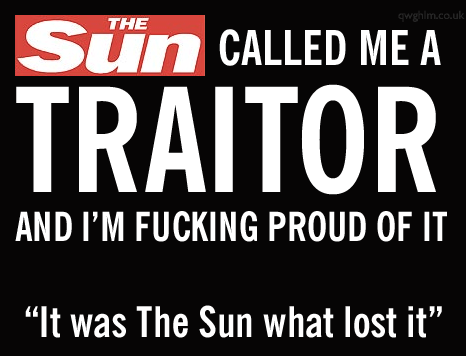
On Friday, the Guardian's cartoon was a bit of a piss-take of their reaction:

Kitty Ussher's justification
In lieu of a lack of response from my MP to the reply to her position on 90-days detention (though to be honest, I only replied on Friday evening, so maybe “her people” haven’t got around to the concerns of her constituents), comes her justification of her position (with a good commentary from Europhobia):
"I very much hope that we will never have another terrorist atrocity in Britain. But if we do, and if it happens because the police have not had sufficient time to accumulate enough evidence to charge the perpetrators, then the Tories, the Lib Dems and our own rebels will have blood on their hands."
Which is pretty much what the reply to my first email was…
Like Tony Blair, Kitty believed that the police and security services asked for these powers and the responsible thing to do was listen to them. The clear fact is that this was not a policy of simply locking someone up for 90 days. There would have been a requirement that a judge reviewed the situation every week and decide whether it was appropriate for a suspect to remain in custody. I think the question on a terrorist act must now fall back onto those who voted against the legislation, what if a suspect commits and act of terror that could have been stopped had the police had 90 days to investigate?
Dear MP of Burnley
In response to last night’s anti-terror vote, I decided to write to my MP, via TheyWorkForYou.com.
I typed in my postcode & it came up with my MP’s details, Kitty Usher.
Looking at her details, I noticed that she voted in favour of having a 90-day detention period, so I wrote the following to her:
Dear Ms Ussher,
Thank you for voting in favour of increasing the maximum detention period of "terror suspects" to 90 days.
It is so re-assuring to know that I do not need to worry about Al-Qaeda wanting to take away my freedom when MPs such as yourself are more than willing to do it for them.
Yours sincerely,
Wonder if I’ll get a reply?
UPDATE: I got a reply on Friday via email (it wasn't addressed to me though... Is this a form reply?):
Like Tony Blair, Kitty believed that the police and security services asked for these powers and the responsible thing to do was listen to them. The clear fact is that this was not a policy of simply locking someone up for 90 days. There would have been a requirement that a judge reviewed the situation every week and decide whether it was appropriate for a suspect to remain in custody. I think the question on a terrorist act must now fall back onto those who voted against the legislation, what if a suspect commits and act of terror that could have been stopped had the police had 90 days to investigate?
Why stop at 90 days? How do you know whether that's a sufficient length of time? What if the incident happens after 91 days? Would we have to extend the period even longer?
Freedom is also relative. Given in France, Spain and Italy a suspect can be charged then basically imprisoned indefinitely so long as an investigating magistrate continues to work on the case, are they less free? I would argue not and this law would come no-where near that.
I have to point out that these countries are not using fear of terrorism to try and force through these sort of laws, only our government is...
I will finally say Kitty is your elected representative and will try to represent your views whenever she can. However given poll after poll after poll showed the public overwhelmingly supported the measure, which side of the argument would you have her take other than the one supported by the police, the public and the party under which she was elected? It is also a fact that today we have had at least 10 to 1 people ring or contact us irate that the measure did not pass.
I guess the astroturf are being activated.
Issues like this always divide people, but as Charles Clarke pointed out this is not a matter of a liberal view against a reactionary view it is a matter of security and if you actually look at what was finally put forward the 90 days was only a small but important part of a wider issue that continued the proper checks and balances. I sincerely hope you are right and 90 days was not needed, but only time will tell.
Kind regards,
Peter Marland
The Office of Kitty Ussher MP
"Working Hard for Burnley and Padiham"
The annotated bits are what I've sent in reply. Wonder what they'll say next time?
18 November, 2005
Hello!
I've set up another blog, mainly for the stuff in the Special Reports section of the links. I'll put stuff in here whenever I can be arsed...
Subscribe to:
Posts (Atom)


