29 November, 2006

Bliar's not as bad as Hitler!

The NO2ID campaign placed the following advert in the Guardian, which resulted in a total of 8 complaints (it's not known how many were from Labour people):


Due to the number of complaints, the Advertising Standards Authority were called to make a decision on whether the ad should be removed due to it causing public offence. They said the following:

The ASA noted the ad had been intended to encourage discussion on a sensitive political issue. We considered that, although the ad may have been distasteful to some, it was unlikely to be seen as making a serious comparison between Tony Blair and Hitler but instead as highlighting a lobbying group's opinion that ID cards should not be introduced because of the threat to civil liberty they posed. We concluded that, as such, the ad was unlikely to cause serious or widespread offence.

You should read the full article including their judgement, it's quite interesting, especially the evidence the NO2ID people use.

27 November, 2006

Thinkpol

From the Guardian:

Police are to demand new powers to arrest protesters for causing offence through the words they chant and the slogans on their placards and even headbands.

The country's biggest force, the Metropolitan police, is to lobby the attorney general, Lord Goldsmith, because officers believe that large sections of the population have become increasingly politicised, and there is a growing sense that the current restrictions on demonstrations are too light.

After all, we all know that SCOPA doesn't go far enough...

The civil rights group Liberty said the powers would make the police "censors in chief".

I guess SCOPA isn't enough!

Trouble at recent protests involving Islamic extremists has galvanised the Met's assistant commissioner, Tarique Ghaffur, into planning a crackdown... Mr Ghaffur has previously advocated banning flag burning. But this document would take the police a lot further. Mr Ghaffur says there is a "growing national and international perception" that the police have been too soft on extremist protesters, which has led to rising anger across the country. "The result has been to create an imbalance in public perception that is manifesting itself in passionate responses from elements of the community not traditionally given to publicly protesting. What we are seeing in effect is a rise in the politicisation of middle England and the emergence of a significant challenge for capital city policing."

Aside form the fact that people having opinions is obviously a bad thing in this country, this sort of thing causes "the politicisation of Middle England". As Issac Newton said "For every action, there is an equal but opposite reaction".

As well as the absence of a law banning the burning of a flag, there is no law banning the burning of a religious text.

... and? Is just a book - no-one's harmed by it.

"There must be a clear message that we will not allow any extremist group to display banners or make public statements that clearly cause offence within the existing law," the document says.


Someone will always be offended, no matter what you do. What's worse is that some people will claim to be offended. How will you be able to distinguish actual "offence" from feigned "offence"?

A solicitor who has defended protesters, Mike Schwarz, said: "Causing offence, if there is no other ingredient, is not against the law." He said such proposed powers would clash with article 10 of the European convention on human rights which protects freedom of expression.


Damn right it would, although, unfortunately, the Human Rights Act is a bit of a waste (if a law if found to conflict with it, the law is still valid and enforceable, it's up to the politicians to decide whether to change it. Do you really think they'd amend or scrap a law which made it easier for people to protest? Of course they would...)

17 November, 2006

RFID passports cracked!

From the Guardian:

"The information contained in the chip is not encrypted, but to access it you have to start up an encrypted conversation between the reader and the RFID chip in the passport.

"The reader - I bought one for £250 - has to say hello to the chip and tell it that it is authorised to make contact. The key to that is in the date of birth, etc. Once they communicate, the conversation is encrypted, but I wrote some software in about 48 hours that made sense of it.

"The Home Office has adopted a very high encryption technology called 3DES - that is, to a military-level data-encryption standard times three. So they are using strong cryptography to prevent conversations between the passport and the reader being eavesdropped, but they are then breaking one of the fundamental principles of encryption by using non-secret information actually published in the passport to create a 'secret key'. That is the equivalent of installing a solid steel front door to your house and then putting the key under the mat."

Within minutes of applying the three passports to the reader, the information from all of them has been copied and the holders' images appear on the screen of Laurie's laptop. The passports belong to Booth, and to Laurie's son, Max, and my partner, who have all given their permission.

Booth is staggered. He has undercut Laurie by finding an RFID reader for £174, which also works. "This is simply not supposed to happen," Booth says. "This could provide a bonanza for counterfeiters because drawing the information from the chip, complete with the digital signature it contains, could result in a passport being passed off as the real article. You could make a perfect clone of the passport."

"The problems could get worse when they put fingerprint biometrics on to the passports. There are established ways of making forged fingerprints. In the future, the authorities would like to have automated border controls, and such forged fingerprints [stuck on to fingers] would probably fool them.

"But what about facial recognition systems (your biometric passport contains precise measurements of key points on your face and head)? "Yes," says Grunwald, "but they are not yet in operation at airports and the technology throws up between 20 and 25% false negatives or false positives. It isn't reliable.

It takes around four seconds to suck out the information with a reader; then it can be relayed and unscrambled by an accomplice with a laptop up to 1km away. With a Heath Robinson device we built on Tuesday using a Bluetooth antenna connected to an RFID reader, Laurie relayed details of his son's passport over a distance of 10 metres and through two walls to a laptop.

There's more on Wired:

In other words, electronic passport theft is about as handy as regular, commercial identity theft. The real hell would come if the authorities didn't bother to stare at the passport but simply trusted the signal from the chip. Which was supposed to be the idea in the first place: these arphids are supposed to be making transit SAFER AND FASTER AND MORE CONVENIENT, not just introducing a new level of Rube Goldberg snafu.

If we simply returned to the security situation status quo ante on 9/10 instead of 9/11, it would be like the civilized world suddenly got over a massive, self-inflicted stupidity virus. Furthermore, we'd be a lot safer.

There's always hope...

The People vs ID Cards

From the Mirror:

[R]eaders of the Yorkshire Post were asked in a phone-in poll if Identity Cards should be made compulsory. Seventy-six [%] said "No", and 24 per cent said "Yes".

Tony's wrong about saying people support the things then...

15 November, 2006

Delays and extra costs

From Computer Weekly:

Computer Weekly has learned that the Identity and Passport Service is running more than a year behind schedule on an online passport system that is far simpler than the ID cards scheme and costs less than one hundredth of its price.

If they can't do it with something a lot simpler, what makes them think they'll succeed with ID cards?

No wonder the government's going to Court to overturn a ruling under the FOIA that it has to release it's costing of the ID cards project. It would also explain why the roll-out for ID cards to those of us who aren't Johnny Foreigner has been put back to 2009.

13 November, 2006

How things change...

From Peter Black (Lib Dem Member of the Welsh Assembly for SW Wales) on Bliar's comments on ID cards:

In a speech to the Labour Party Conference on 3 October 1995, Tony Blair outlined how he was going to be tough on crime. This included a passage on ID cards:

"We all suffer crime, the poorest and vulnerable most of all, it is the duty of government to protect them. But we can make choices in spending too. And instead of wasting hundreds of millions of pounds on compulsory ID cards as the Tory Right demand, let that money provide thousands of extra police officers on the beat in our local communities. But the truth is that the best two crime prevention policies are a job and a stable family."


What made him change his tune?

11 November, 2006

More technological problems with ID cards

From the Register:

The EU-funded FIDIS (Future of Identity in the Information Society) project has warned that implementation of the current generation of biometric travel ID will dramatically decrease security and privacy, and increase the risk of identity theft. In the Budapest Declaration, which derives from FIDIS' September meeting in Budapest, FIDIS calls for short-term damage control measures to be taken (because biometric ID is already being rolled out), and for "a new convincing and integrated security concept" to be developed within the next three years.

FIDIS points out that the new generation of biometric Machine Readable Travel Document (MRTD) is remotely readable at a distance of 2-10 metres, and that current security simply isn't good enough to protect it.

The most significant problems with these MRTDs are:

  • Biometrics in MRTDs currently cannot be revoked and since biometric features of the users such as fingerprints and facial features cannot easily be changed, "stolen" biometrics can be abused for a long period of time
  • The key to access data on the RFID tag is stored on the passport itself and can be read by humans and machine scanners.
  • Eavesdropping of communication between RFID tag and reader
  • Cloning of RFID tags in MRTDs
  • Abuse of the remote readability of RFID tags in passports

Even more evidence against ID cards, not that Blair’ll listen of course…

09 November, 2006

The Citizen Registration Programme II

I've previously mentioned where the ID cards centres will be based.

Well, NO2ID have a list of the locations where the ID card processing centres will be based. There appears to only one for the whole of London, in Victoria. Some of them, e.g. Blackburn, require planning permission. To any one in the area: lodge lots of complains and then there'll be a public enquiry over the location.

07 November, 2006

CCTV is a waste of time

In my fisking of our Dear Leader yesterday, I questioned the evidence about the effectiveness of CCTV, which our Dear Leader says the public support.

Thanks to Not Sassure, I've come across a report by the Information Commissioner which says:

During the 1990s the Home Office spent 78% of it crime prevention budget on installing CCTV46 and an estimated £500M of public money has been invested in the CCTV infrastructure over the last decade. However a Home Office study concluded that ‘the CCTV schemes that have been assessed had little overall effect on crime levels’.

The Home Office study itself also has the following (on p. vi)

Out of the 13 systems evaluated six showed a relatively substantial reduction in crime in the target area compared with the control area, but only two showed a statistically significant reduction relative to the control, and in one of these cases the change could be explained by the presence of confounding variables. Crime increased in seven areas but this could not be attributed to CCTV. The findings in these seven areas were inconclusive as a range of variables could account for the changes in crime levels, including fluctuations in crime rates caused by seasonal, divisional and national trends and additional initiatives.

and this (p. 48):

[T]he presence of CCTV in an area actually increases worry about crime, possibly because the assumed need for CCTV to be installed makes the area seem more problematic than the respondents had previously thought.

A government report contradicts Blair's own arguments... any other reasons you wanna try, Tone?

06 November, 2006

Bliar's reasons for ID cards

Our Dear Leader's written an article in the Telegraph: about why we need ID cards. Let's fisk it shall we?

The case for ID cards is a case not about liberty but about the modern world. Biometrics give us the chance to have secure identity and the bulk of the ID cards' cost will have to be spent on the new biometric passports in any event.

Yet..

I am not claiming ID cards, and the national identity database that will make them effective, are a complete solution to these complex problems.

So he admits they're a failure!

Nor is the Government alone in believing that biometrics offer us a massive opportunity to secure our identities.

How about some evidence?

I am convinced, as are our security services, that a secure identity system will help us counter terrorism and international crime.

Speak to people in Madrid about this...

It will also help us tackle the problem of identity fraud, which already costs £1.7 billion annually

By having a big, centralised database of everyone's details?!

The National Identity Register will help improve protection for the vulnerable, enabling more effective and quicker checks on those seeking to work, for example, with children. It should make it much more difficult, as has happened tragically in the past, for people to slip between the cracks.

Praying on the public's fear of Paedophiles & Ian Huntley. Not a reason, barely an excuse... Anyway, what if the data's wrong? Who pays for screwing up people livelihoods?

Crime detection rates, which fell steadily for decades, should also be boosted. Police... will be able to compare 900,000 outstanding crime-scene marks with fingerprints held centrally.

No such thing as a presumption of innocence then... not bad for a Barrister.

Biometric technology will enable us, in a relatively short period of time, to cut delays, improve access and make secure a whole array of services.

See the LSE's ID cards report on the problems involving biometrics...

It should prevent us having to tell every agency individually when we move house. In future, we could be automatically alerted when our passports are running out.

A fantastic use of £X billion! I'm sure people are capable of looking at the inside of their passport for the expiration date...

I know this will outrage some people but, in a world in which we daily provide information to a whole host of companies and organisations and willingly carry a variety of cards to identify us, I don't think the civil liberties argument carries much weight.

A lot of completely separate databases - which are completely voluntary and free - are a hell of a lot better than one costing billions and is compulsory. Also the worst thing about the current ones is junk mail, not thousand pound fines and a criminal record!

Individuals will have the right to see what information is held on them; the register will not contain medical records or tax and benefits information

... at the moment... anyway, Tony, your own government has said medical records WILL be on there!

It was also very clear from last week's arguments about surveillance and the DNA database that the public, when anyone bothers to ask them, are overwhelmingly behind CCTV being used to catch or deter hooligans, or DNA being used to track down those who have committed horrific crimes. And that's what surveys suggest, too, about their position on ID cards.


Any chance of evidence of the effectiveness of CCTV? As far as I can tell it just moves crime into another area - this is used an excuse to have more cameras, not scrap 'em on the grounds of being completely ineffective... Surveys, apart from Home Office ones, show that the more the public know more about ID cards, the less they want them!

On present estimates, biometric passports make up 70 per cent – or around £66 – of the cost of the combined passports/ID cards we want. The additional cost of the ID cards will be less than £30 — or £3 a year for their 10-year lifespan.

Any chance of letting us see the evidence for this Tony? after all the innocent have nothing to fear, do they?

He also did a press conference today, which gave another "reason":

But he believed that it was more an issue of "modernity" and of "modern life" - and he backed the use of these new technologies to tackle the new types of crime.

In that case, I want to be Old Skool, mutha'fucka!

But he also confirmed the timetable for Britons' cards has slipped to 2009.

A potential election year - that'll be fun!

The Tories have it right:

"He claims they will deal with benefit fraud, whilst his own minister pointed out that 95% of benefit fraud is caused by people lying about their circumstances, not their identity.

"He claims they will tackle terrorism, whilst his home secretary on the 7th July last year said 'I doubt it would make a difference'.

"...Microsoft tells us it is more likely to trigger identity fraud on a massive scale.... it will almost certainly cost £20bn, will solve very few problems... it will be Labour's final act of ineffective and expensive authoritarianism."

So have the Lib Dems:

"All the evidence from Britain and abroad shows that big government databases just become the favoured target for ever more sophisticated organised criminals."

UPDATE: Reading Bliar's comment about them preventing terrorism reminds me of a quote from the sorely-missed World Weary Detective:

The scene: An anonymous provincial town in middle England somewhere. Four plotters gather together in a darkened room. The year is 2008.

Plotter 1: Right everyone. Today is the day. Is everyone ready?

All: YES!

Plotter 1: Is everyone a 'clean skin' that has avoided the attention of the greatest security agencies in the world?

All: YES!

Plotter 1: Does everyone have a rucksack packed with explosive?

All: YES!

Plotter 1: Is everyone fully aware of our warped religious justification for committing mass murder?

All: YES!

Plotter 1: Is everyone suitably brainwashed that they will follow my commands without question?

All: YES!

Plotter 1: Is everyone willing to die in the name of their cause?

All: YES!

Plotter 1: Is everyone in possession of their ID cards?


All: Errr...


Plotter 1: What? What if you require access to key services on the way to cause carnage on the transport infrastructure of Britain?

All: Err...

Plotter 1: Right that's it. Take off those bloody suicide belts. No ID card no mass murder. If it wasn't for that blasted Blair we would have got away with it....

28 October, 2006

Government censors evidence of corruption

From the Guardian:

The government was yesterday scrambling to recover secret documents containing evidence suggesting corrupt payments were made in Britain's biggest arms deal. The documents, published in full today by the Guardian, detail for the first time how the price of Tornado warplanes was inflated by £600m in the 1985 Al Yamamah deal with Saudi Arabia. A telegram with the details from the head of the Ministry of Defence's sales unit had been placed in the National Archives. Yesterday it was hastily withdrawn by officials who claimed its release had been "a mistake".

A PDF of the agreement is here.

A telegram relating to the progression of the sale (PDF).

A briefing to the government about the sale is here (PDF).

A PDF of minutes of the meeting between the government & the Saudis.

23 October, 2006

How much will they cost?

From the Yorkshire Post:

A devastating document slipped out by the Government yesterday revealed that the Home Office believes it is impossible to work out exactly what ID cards will be used for, and what biometric data they should hold, until after they are introduced.


A solution looking for a problem...

Home Office Minister Liam Byrne insisted last week that the scheme would cost £5.4bn over 10 years, close to previous official estimates, and that it would be introduced according to plan from 2008.

But his claims were spectacularly contradicted last night in the Government's official reply to a hard-hitting report published by the Commons Science and Technology Committee addressing flaws in the project.

The reply is in paragraph 32 on pages 23-4.

The cost estimates published are based on a reference design and as such are improved and revised as our understanding of the underlying cost assumptions improves. These will continue to be refined through discussion with the market and comparisons with appropriate benchmark projects throughout the procurement and, therefore, remain flexible... Whilst we are keen to remain open and transparent on the level of detail provided to the public in the cost estimates for the programme, we must also protect the commercially sensitive information of our suppliers. The price that they are charging for the technology services will be commercially sensitive.

Sounds about right for Labour - private profit above public need... How much are they going to waste on them before realising they're an awful idea, which no-one wants? I'm assuming a hell of a lot, as the government are incapable of admitting they're wrong & our only hope is that Labour are thrown out a the next election, and replaced by preferably a Tory-Lib Dem coalition, which won't be until either 2009/10...

I like this reply in paragraph 38 on page 28:

During the development of the Identity Cards Programme there is no evidence that Government has thus far imposed politically-motivated deadlines, and no timetable is dictated by the legislation.

Oh really? See one of my previous posts which had the following from the FT:

Labour plans to race forward with the contentious identity cards scheme to ensure the multi-billion pound infrastructure is up and running before the next election, neutering a Tory pledge to scrap it.

But Andy Burnham, the home office minister responsible for the scheme, said Mr Cameron’s “throwaway line” would be rendered irrelevant by the rapid roll-out of the scheme. He said it would be a fait accompli by the 2008 or 2009 expected date of the next general election. “I’m keen to see plenty of ID cards in circulation come the next election,” he said. “The whole landscape will have changed by the time if – and it’s a big if – the Tories ever get anywhere near power.”

How can they make such a blatant lie in an official reply of all places?

22 October, 2006

In the Designated Area (III)...

Finally got around to stick up some photos from last Wednesday's protest - sorry it's taken a while, but I've been busy.

I got there slightly late - bloody District Line being delayed & then making me change trains... Anyway, lots of new people there this time, but strangely no Mark Thomas, despite the fact it's his idea!

Unfortunately, I don't have as many photos this time - ther're on Flickr of course - as the batteries in my camera ran out & I didn't have any spares. Kinda pissed me off as there was some old woman in a fantastic costume protesting against the Russians killing journalists. Just wished I'd managed to get a photo of her beforehand...


10 October, 2006

White people are terrorists too!!!!!!

A mate emailed this story from the Nelson News:

TWO Pendle men have appeared before Pennine magistrates accused of having "a master plan" after what is believed to be a record haul of chemicals used in making home-made bombs was found in Colne.

Robert Cottage (49), of Talbot Street, Colne, and David Bolus Jackson (62)...

The 22 chemical components recovered by police are believed to be the largest haul ever found at a house in this country.

Cottage is an ex-BNP member who stood as a candidate in the Pendle Council elections in May.

To quote my mate's email:

Funny how this didn't get coverage - but if their names had been Abdul and Mohammed it may have been different...

24 September, 2006

In the Designated Area (II)...

On Friday I went along to the Parliament protest to register my disgust at various items:


There seemed to be slightly less people this time - only about 100 - but there was a lot of different people from last time, so maybe the word is spreading...

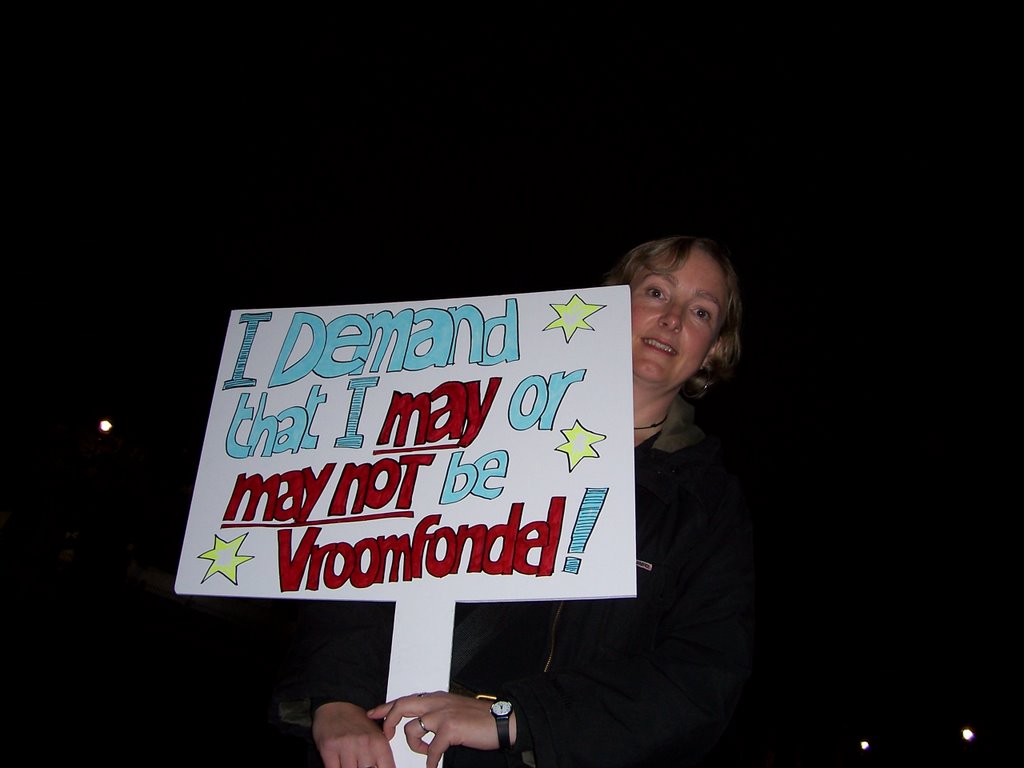
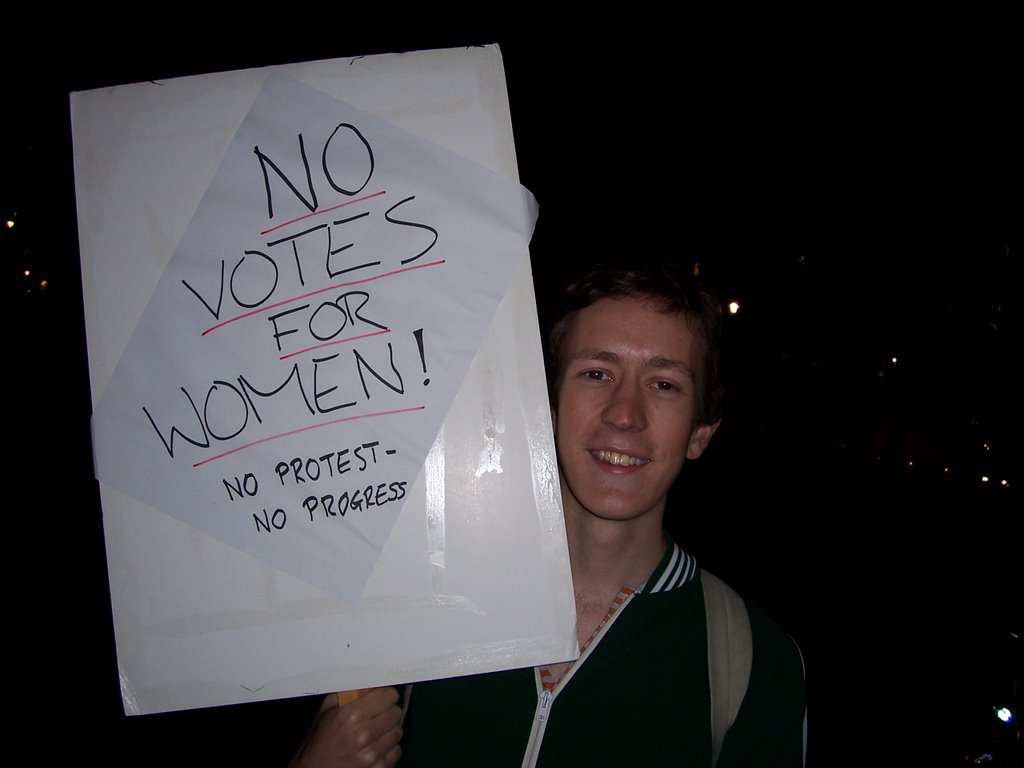
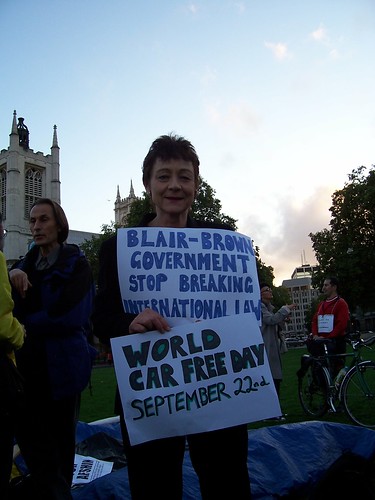
Some of my favourites:


We also had some political representation in the name of London's Lib Dem MEP Sarah Luford.


Hopefully at the next one there'll be more of our elected representatives...

I've got a load more photos over on Flickr.

From now on it’s a monthly thing, taking place the third Wednesday of the month. The next one is on 18th October, with the forms being handed in on 11th October.

I’m actually thinking of going along to the next one, but not getting permission in advance. What I’ve noticed with the other two that I’ve been to is that the police don’t check whether you have the forms, as long as there’s quite a big group of you present. So, what I’m thinking of doing is not getting permission, but still go and protest, just to see what the police actually do… anyone else interested? Of course, there can’t bee too many of us without permission, as it’d ruin it completely, and, obviously, the police would have a record of the number of people who’ve been given permission and the numbers actually present.

15 September, 2006

Applying for Permission...

I went and handed in my form for next week’s protest – this time you have to protest against two things:

  1. “Radiohead”: their song “No Surprises” contains the lyrics “Bring down the government/They don’t, they don’t speak for us” which I feel is apt…
  2. “Pointless bureaucracy”: the fact that I have to spend my precious free time filling in a form and then having to traipse along to the police station to get them to sign and authorise it which also wastes their time.

While I was doing this I bumped into Davide of Nether-World and Blairwatch and we went to the pub for a few drinks and talked about various things…

On my way home, I got a call off the police! They said that they were unable to authorise my protest as I’d asked for permission to protest within the entire “Designate Area” which they said was not allowed! I then said “In that case, please can you change it to Parliament Square?” which was acceptable…

02 September, 2006

In the Designated Area...

Last week, I queued up to hand in my form for the Lone Protest (for which I was given permission). Unknown to me was that people were taking photos of us handing in our forms, and that one picture (from Davide on The Nether-World) did capture me in all my “glory”. There was one woman who gave her permission on a cake – I like it. Next time I’ll do summat other than fill in the form – anyone got a suggestion?

On Wednesday evening – sat at home killing time on the Internet, as it was the day before payday – I got an email off Tim Bloggerheads inviting me for a piss-up afterwards. After spending a few seconds considering the consequences: give up the (relative) anonymity he has built up over the past 16 months to meet people whose rantings and ravings he reads in exchange for alcohol. I realised, to quote that great philosopher Homer, “Ahh, beer! My one true weakness, my Achilles-heel if you will”, so, yeah!

On Thursday, after a “busy day” at work, I run to the train station to make my date with destiny. I got to the protest at 5:45pm but due to my permission letter, I’m unable to bring out my sign, as the permitted time hasn’t yet started, so I was just talking to people…

At 6pm Big Ben chimes and it starts – 200 people, all protesting different things, but at the same time and in the same place – lots of noise, from Brian Haw – who needs a car battery for his megaphone; has anyone got one they don’t need? – through to me “No to ID Cards”, as per my sign. Others I enjoyed were the campaign to ban Robbie Williams for crimes against music – which I wholeheartedly agree with – demanding improvements in public transport, namely the North London Line, people showing the absurdity of the law as people have been arrested for reading newspapers and the Socialist Wanker.

The other bloggers who I spoke to were Justin – protesting to ban everything, as well as to legalise everything [I’m now in possession of it. Justin left it in the pub and, as it would have been a waste of all the time and effort he put in, I decided to rescue it (this isn’t theft as he gave me permission to do it!). I got quite a lot of looks when I was walking back to the train station and I’m a bit surprised as I was holding it up on my shoulder within the Designated Area and so this could have been classed as an illegal protest]; Tim – demanding his £2000 from Transparent Tony (see here for the background), Rachel – demanding an inquiry to the 7th July bombs and Davide – protesting against invasions of our privacy [I can't seem to find a photo with your sign, sorry!].

See here for my photos, while other people have put theirs on here, London Daily Photo, Chris King or on the official Mark Thomas website).

BBC London were there doing a report (I’m briefly in the background at 1:27.2) which has an argument between the organiser Mark Thomas and Brian Coleman, the Tory member of the London Assembly for Barnet & Camden (his view boils down to “Money is more important than freedom of expression.” Please, if he is your “elected representative” vote this guy out)

At 6:45 Tim announced that he had permission to march on Downing Street, in order to collect his money off our Dear Leader. We sent off and Tim used Rachel’s banner as a loudspeaker to get Bliar’s attention (stolen from Justin’s moblog). Unfortunately, our Dear Leader is too much of a deadbeat to pay up. [Tim, how about sticking an ASBO on him? Or, as you’re claiming money for services provided for him, sue his arse for breach of contract! Free legal advice: you’ve got 7 years from when the breach occurred to issue court proceedings. As you sent the invoice in 2003, you’ve got plenty of time!].

Then we went to Bliar’s local, the Red Lion – the pub opposite Downing Street – for many a drink, where we discussed politics and blogging (Chris King seems to have taken photos of the gang itself! Yay!). Nice to see that real-life is no different to t’internet life ;-)

Not everyone was impressed by our actions: the Devil’s Kitchen, who slags off the government more than anyone, is having a go at those of us who dare to protest against the government! Dickhead… all talk, no action…

Oh yeah, everyone there got a badge of honour. I wonder how many have gone on eBay?

26 August, 2006

Permission granted!

As you know I went to the Charing Cross Station on Thursday.

Well, this morning I received the following letter from the Metropolitan Police Force:

Re: Demonstration – ID Cards received 24 August 2006-08-26

Dear Mr. D-Notice,

I, Superintendent [some Copper], give authority under s. 134 Serious Organised Crime and Police Act 2005 for your demonstration to proceed on 31 August 2006 between 6pm and 7pm in Parliament Square.

I do not intend to impose any conditions on your event.

In the event that your demonstration causes any of the following, the senior police officer in attendance may impose conditions on you and the participants

(a) Hindrance to any person wishing to enter or leave the Palace of Westminster,

(b) Hindrance to the proper operation of Parliament,

(c) Serious public disorder,

(d) Serious damage to property,

(e) Disruption to life in the community,

(f) A security risk in any part of the Designated Area

(g) Risk to safety of members of the public (including any taking part in the demonstration)

Yours sincerely,

[some Copper]

Yay!

Let’s see what happens!

Protest

Well, as promised, I went to the Charing Cross Police Station to apply for a protest within the "Designated Area", i.e. within 1 km of Parliament.

After being in the queue for 1 hour, briefly speaking to Mark Thomas and others - hello to the guy protesting to highlight the plight of the crayfish - I managed to get my form signed and stamped to enable me to protest aainst ID cards next Thursday, at 6 pm.

Now all I have to do is wait for the poice to send me a letter authorising my protest and seeing what restriction they put on it. I'm assuming only one placard and no loud-speakers...

Let's see what happens!

22 August, 2006

The Citizen Registration Programme

I know this is late – going on the date of the article, it was just after I’d moved down to the Village and so was without the t’internet – but I’ve only just discovered – via Blair Watch – the locations of the ID card registration centres.

Of interest to me are the ones for London, as well as the ones for back home Oop t’North-west and also north Wales, which are as follows:

Blackburn

I gown up in east Lancashire and I can have a real go at this.

They’re expecting one office – in Jack Straw’s constituency – to serve not only east Lancashire (Blackburn, Burnley, surrounding areas, total pop. approx 250,000), but it appears they’re also expecting it to serve central Lancashire (Preston, Chorley and possibly Bolton), which will have a greater population, and it appears they also want it to Blackpool (pop. 125,000), Morecambe and Lancaster (total pop. 200,000) which will be a real bastard to get to Blackburn from. From experience I know it’ll take the best part of an hour from Blackpool on the train, but at least it’s direct; for Morecambe and Lancaster you’re expecting people to travel for more than an hour and a half on the train (the road is a no-no, as it’s the M6!) with at least one change in Preston! That or they’re expecting you to travel to Kendal, i.e. the Lake District, which will be even worse for public transport, due to it being a rural area!

In total they expecting one office, in an area with bad public transport, to serve the best part of 1 million people!

Liverpool

Manchester

Obvious choices: biggest cities in the area and can catch a lot of the out-lying areas.

Wrexham

This is a bit of a strange choice. Yes it’d be useful for Chester & western Cheshire and north-Staffordshire, but what about people in the rest of north Wales? I’ve got family in north Wales and so I know how bad the public transport is: small, crappy buses, very slow trains (where they exist, i.e. not everywhere). Anywhere west of Rhyl and you’re fucked with this office, especially if you’re one of the island-dwellers (Anglsey/Ynys Mon). There is the possibility of using the one in Aberystwyth, but, again, the problems with public transport apply, possibly more so. They could use the “Remote Communities Service” which will consist of a webcam – nothing like using a secure system, with high resolution pictures! It’s ideal for ID cards!

As for the Village:

London

One centre?! One fucking centre?! One fucking centre to serve 8 million plus people?! As well as the out-lying suburbs? Are they serious? Fair enough there is the (very slight) possibility of those in western London using the Reading centre and those in the far south of London and Surrey using the Crawley one, but come on…

There’s a map on the locations of centres here.